Giving solid-state batteries a squeeze keeps them from short-circuiting
SLAC and Stanford researchers found that compressing solid-state battery material reduced the formation of lithium-filled intrusions called dendrites, leading to faster charging and longer battery life.
By Emily Ayshford
Key takeways:
- A SLAC/Stanford University research team found they could prevent short-circuiting of solid-state batteries by deflecting the dendrite propagation direction using mechanical compression.
- They provided direct evidence that dendrites start in the interior rather than merely at the surface of the electrolyte, settling a long-standing debate within the field.
- The results could have implications for future battery design, by incorporating built-in mechanical compression or electrolytes with more defect-free interiors that suppress dendrite initiation.
Lithium-ion batteries power transportation and grid storage and enable our digital lives, but these ubiquitous batteries require frequent recharging and can fail over time.
To make batteries more reliable and longer lasting, researchers are exploring how to replace liquids inside batteries with a solid ceramic substance that could improve their performance.
But researchers must first overcome a big problem: cracks filled with lithium that form within the solid material during charging, causing the batteries to quickly short-circuit. When that happens, devices powered by these batteries become useless.
Researchers have long debated whether these cracks and the lithium metal inside them, called dendrites, form at the surface or inside the solid material – a key insight needed to figure out how to stop them from forming.
Now, in a study published in the journal Nature, researchers have discovered a way to track these dendrites and suppress them enough to keep the battery from short-circuiting.
“We want to make reliable, energy-dense batteries that are fast charging,” said Teng Cui, who conducted the research while a postdoctoral researcher at Stanford University and part of a team at the SLAC-Stanford Battery Center – a partnership between the Department of Energy’s SLAC National Accelerator Laboratory and the Stanford Precourt Institute for Energy. “This research shows us several of the steps that need to happen to make that possible.”
When charging a solid-state battery, lithium ions flow from the positive electrode through the solid ceramic electrolyte to the negative electrode. When these lithium ions find their way into nanoscopic defects, they can harden into lithium metal, forming dendrites.
Because the dendrites are so narrow – thinner than tens of nanometers – and the propagation happens so quickly, researchers have found it nearly impossible to tell whether they begin at the surface or within the bulk of the electrolyte material.
Assistant Professor, University of Waterloo, CanadaWe want to make reliable, energy-dense batteries that are fast charging. This research shows us several of the steps that need to happen to make that possible.
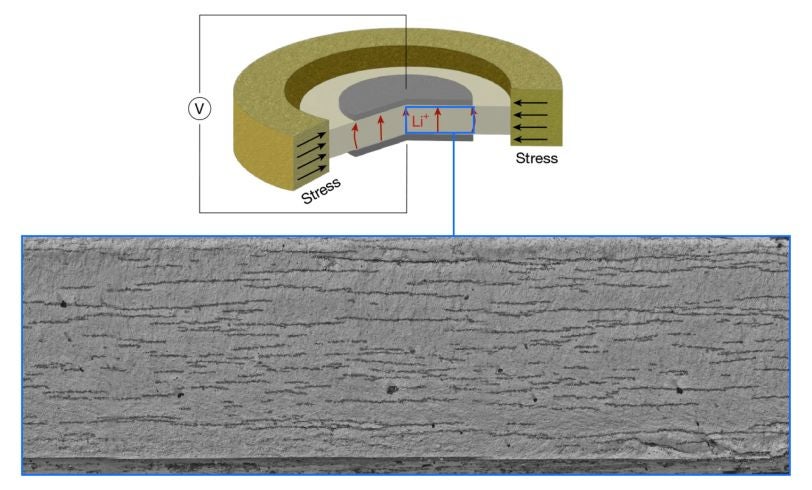
The team found that when they applied a metal ring to compress the solid electrolyte, it prevented vertical dendrites – the kind that cause short-circuiting – from forming during charging.
In fact, under this compression, batteries lasted for thousands of cycles. While vertical dendrites did not form, horizonal dendrites formed internally, but these did not reach the electrodes and therefore did not cause immediate short-circuiting.
The results both settle the debate, finding that dendrites form at internal defects within the electrolyte, and also show that this squeeze could be employed as a design feature so these batteries can be used long-term.
To keep a battery working, give it a squeeze
Researchers are eager to make solid-state batteries work, because they could provide double the energy density of current batteries.
“These batteries could ultimately offer higher energy density and improved reliability,” said Wendy Gu, associate professor of mechanical engineering at Stanford, who co-led the study with William Chueh, director of the SLAC-Stanford Battery Center and the Stanford Precourt Institute for Energy, professor of photon science at SLAC, and professor of materials science & engineering and energy science & engineering at Stanford.
Associate Professor, Stanford UniversityThese batteries could ultimately offer higher energy density and improved reliability.
Dendrite propagation can happen within seconds, and when those dendrites reach the battery’s electrodes, they cause the battery to short-circuit.
Cui, a mechanics expert, used his knowledge of fracture mechanics to propose controlling propagation of the dendrites using mechanical stress. He and the team created a shape-memory alloy ring – a metal ring that changes shape when heated – and placed it around the solid electrolyte. When they heated it to 170 degrees Celsius, it shrank down to compress the battery.
Under compression, dendrites still formed during charging, but they spread horizontally instead of vertically.
The team found that dendrites form on two timescales: The surface dendrites form quickly, but if they are suppressed, the internal dendrites form later. X-rays at SLAC’s Stanford Synchrotron Radiation Lightsource (SSRL) showed that the internal dendrites did not change the bulk crystal structure of the electrolyte when they formed at defects within the material, including pores and grain boundary junctions.
Creating new design parameters for batteries
What the team didn’t expect was just how long they would be able to keep the batteries working. Even after thousands of charge cycles and the formation of many internal dendrites, the batteries still worked – proving that their testing mechanism could also be a potential design feature for batteries.
“We generated an unprecedented number of dendrites,” said Cui, who is now an assistant professor at the University of Waterloo, Canada. “But the dendrites did not short the battery. It shows that there is this intimate relationship between mechanics and electrochemistry that could lead to new design strategies for batteries.”
To help prevent internal dendrites, researchers could design a solid electrolyte with extremely low electronic leakage that has a smooth surface and a pristine structure inside. Engineers could also design a system in which the electrolyte is under a constant squeeze.
Next, the team will focus on the interfaces between the cathode and anode and the electrolyte, working to make the contacts between the materials as good as they are with liquid electrolytes.
“Many different areas of expertise came together – mechanics, electrochemistry and characterization – to make this work possible,” Chueh said. “Insights synthesized in this work provide an actionable pathway to advance solutions for the energy-storage grand challenge.”
Director of the SLAC-Stanford Battery Center and the Stanford Precourt Institute for Energy; Professor, SLAC and Stanford UniversityInsights synthesized in this work provide an actionable pathway to advance solutions for the energy-storage grand challenge.
In addition to SLAC and Stanford, the team also included researchers from Kyungpook National University in South Korea and Arizona State University.
This work was supported by the Department of Energy’s Technologies Transportation Office, Office of Critical Minerals and Energy Innovation; and Basic Energy Sciences, Office of Science. Stanford Synchrotron Radiation Lightsource (SSRL) is an Office of Science user facility.
Citation: Teng Cui et al., Nature, 01 July 2026 (DOI: 10.1038/s41586-026-10734-x)
For media inquiries, please contact media@slac.stanford.edu. For other questions or comments, contact SLAC Strategic Communications & External Affairs at communications@slac.stanford.edu.
About SLAC
SLAC National Accelerator Laboratory explores how the universe works at the biggest, smallest and fastest scales and invents powerful tools used by researchers around the globe. As world leaders in ultrafast science and bold explorers of the physics of the universe, we forge new ground in understanding our origins and building a healthier and more sustainable future. Our discovery and innovation help develop new materials and chemical processes and open unprecedented views of the cosmos and life’s most delicate machinery. Building on more than 60 years of visionary research, we help shape the future by advancing areas such as quantum technology, scientific computing and the development of next-generation accelerators.
SLAC is operated by Stanford University for the U.S. Department of Energy’s Office of Science. The Office of Science is the single largest supporter of basic research in the physical sciences in the United States and is working to address some of the most pressing challenges of our time.
Related stories